

Bhutan
GENERAL INFORMATION
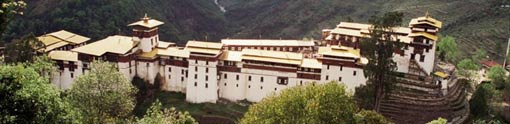
The Kingdom of Bhutan is a Country nestled in the Eastern Himalayas known as Drukyul (in Dzongkha) “Land of Thunder Dragon”, and its people are known as ‘Drukpas’. Bhutan, the last Shangri-La, independent Himalayan Buddhist Kingdom fondly maintains its tradition. It has one foot in the past and one in the future. The Himalayas in the north separate the Tibetan Autonomous Region of China, while the rugged eastern region borders the Indian State of Arunachal Pradesh, in the south by Assam and west Bengal and in the west by Sikkim.
Bhutan is a sanctuary of magnificent scenery in the heart of Himalayas. The country’s history stretches back to the origins of Buddhism and its spiritually rich people are enterprising, Pragmatic and delightfully humorous. They live in harmony with nature and have evolved a unique identity’ derived largely from a religious and cultural heritage. The Kingdom of Bhutan lies in the eastern Himalayas, between Tibet to the north and the Indian territories of Assam and west Bengal to the south.
Monsoon influences promote dense forestation in the region and alpine growth at higher altitudes. The cultivated central uplands and Himalayan foothills support the majority of the population. In the south, the Daurs plain drops sharply away from the Himalayas into large tracts of semi- tropical forest savannah grassland and bamboo jungle.
Area of Bhutan: 47000 Sq/Km
Altitude: Varying from 180m to 7,550m above sea level
Population: 6,50,000
Capital: Thimphu
Location : Bhutan lies between 89o and 92o E and 27o and 28o N.
Local time: six hours ahead of GMT and ½ hour ahead of IST (Indian standard time)
Forest Cover: - 72%.
Agricultural: - 7.8%
National animal: Takin – Bodorcas Taxi Color
National Flower: Blue Poppy, Meconopis granis
National Tree: Tseden, Himalyalca cypress.
National Bird: Raven, Coruas Coraxs
National Sanctuaries: 26%
- Royal Manas Park.
- Thimshingla National Park.
- Phibsoo wild Life Sanctuary.
- Bomdling wild Life Sanctuary.
- Toorsa Strict Nature Reserve.
- Khaling wild Life Sanctuary.
- Sakten wild Life sanctuary.
- Jigme Dorji National park.
- Black Mountain National Park (Jigme Singye).
Language : Dzongkha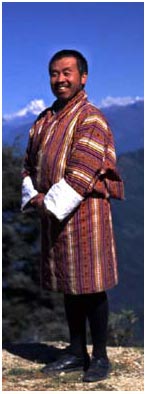
People : There are two main population groups in Bhutan: the Dukpa ( 67 % ) of Tibetan and Monpa origin and Lhotsampa ( 30 % of Nepalese origin ). The rest 3% comprise of indigenous tribal groups such as Toktop, Doya and Lepcha of SW Bhutan.
Religion : Drukpa Kagyu school of Tibetan Buddhism is the state religion but also Nyingma school is also well represented in the central and eastern districts.
Climate : The monsoon starts in mid June and lasts untill end of September. The climate within the mountain varies greatly according to precipitations and wind conditions. In the Duars Plain and upto 1500m. The climate is sub-tropical with high humidity and heavy rain fall. The climate of mid- mountain belt varies, such that low- lying parts of Punakha, Mongar, Tashigang, and Lhuntse have cool winter and hot summer, where as the higher valleys of Ha, Paro, Thimpu, Tongsa and Bhumthang ranging from 3,000 - 4,000m endure a temperate climate with cold snowy winter and some - what cooler summers.
Clothing : Cotton and light woolen in summer ( June - Sept ). Heavy wollens and jackets the rest of the year. Take an umbrella and comfortable shoes for the monsoon.
Economy : In 1995, the per capita income was estimated as US 500 with the annual growth at 5%. Although these figures places Bhutan among the least developed nations, the country is unlike others within that category as no faine, little malnutrition, food housing, exists. Over 91% of the population depends on agriculture and livestock rearing which together account for some 50% of GDP, despite the fact that only 2% of the land is arable.
Money : The National currency is Ngultrum ( Nu ) 100 Chetrum = 1 Nu. Exchange rate is approximately US $ 1 - Nu 35. Indian ruees circulate at par.
NOTE : Please note that all booking has to be made minium 21 days in advance & on conformation full payment has to be made at Calcutta. Rate for accompanied children, upto two yeas - free, & from 02 - 12 years - 50% of the package cost without extra bed. Maximum two children below 12 years are allowed to share room with parents. If the child is found above 12 years, the respective hotels will charge the full adult rate directly, and so communication in this regard will be entertained on the same later on.