KANCHANJUNGA BASE CAMP TREKKING
Trip
Overview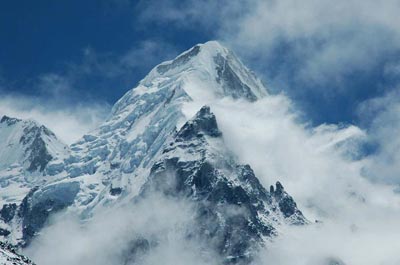
The Kanchenjunga area was first opened to organised trekking in 1988. Prior
to that, the only westerners to have explored the area were those on
mountaineering expeditions.
"Kang-chen-zod-nga", meaning "Five Great Treasuries Of The Snow", actuallys,
has seven major summits. To the locals Kanchenjunga (8585 m.), the third
highest mountain in the world, is the abode of gods who bestow prosperity
and benovelence on them and their lands but, to climbers of this mountain
the phrase "Five Great Treasuries of the Snow" takes on a slightly more
ominous tone. The avalanches that Kanchenjunga throws down are said to be
the largest anywhere! Since the locals venerate the mountain, there is a
tradition among mountaineers not to stand on the actual summit. All
"successful" assaults have stopped just short of the summit honouring an old
promise made by the leader of the first successful attempt in 1955 to the
maharaja of Sikkim.
Kanchenjunga is on Nepal's eastern border with the Indian State of Sikkim.
The lowland areas are culturally rich but there are few good mountain views.
There are shops, but these are geared to cater to the local inhabitants and
not the tourist. One must always carry all of one's provisions into the
region. Your last shopping chance will be at Kathmandu.
The major ethnic group inhabiting the Kanchenjunga region is the Limbus who
along with Rais belongs to the broader "Kiranti" group. Both these peoples
have earned respect as fearless infantry men-the "Gorkhas". Infact, till
some years ago, the only serving Victoria Cross holder in the British Army
was a Limbu. The Limbus can be recognised from their headgear "topi" which
is identical to the national headgear of Nepal but taller and more colorful.
If you are lucky to pass through major Limbu villages during the first of
the Nepali month you may be able to witness village fairs which mainly serve
as an excuse for the younger generation to go courting. Nevertheless, these
are fun times and offer great photo opportunities.
By far the more famous contribution of Limbu culture is the millet drink "tongba"
which is served in special wooden "tongba pot". Fermented millet seeds are
put in the tall pot and hot water added. Then the potent brew is drunk via a
thin bamboo straw, with tiny holes, which act as filters and keep the seeds
out. When all the liquid in one pot has been drunk, hot water is added to it
again and the process repeated. Look out for this speciality north of
Basantapur. Please seek your sirdar's advice on the quality of the brew and
consume sparingly.
Your journey to unlock the secrets of this remote area begins with a flight
from Kathmandu to Taplejung (Suketar) in the east of Nepal. From Suketar you
head to Chauki annd from there through the villages of Mitlung, Ghunsa,
Khambachen and Lhonak to Pangpema (5140 m.) which is also the Base Camp for
expeditions attempting the North Face of 2Kanchenjunga and the culmination
of the first part of the trek.
This strenuous and extended trek visits both sides of the peak but, as with
all treks that spend protected times at high altitudes it requires
determination and some luck to complete the trek successfully. The crossing
of high passes requires good weather - snow could mean that the trail has
become dangerous for travel and heavy rains often cause landslides that wipe
out whole sections of trails. Protracted stays at high altitude requires
that participants on this trek be in peak physical condition and the
duration of the trek requires that no member of the party falls ill. These
factors, of course, can not be controlled or predicted. Medical facilities
are few and far between and emergency evacuation involves great cost and
mind boggling logistics. Therefore, it is highly recommended that each and
every participant on the trip have trip cancellation insurance, which also
covers emergency evacuation, by air.
Itinerary
Day 01: Arrive at Kathmandu & Transfer to Hotel.
Day 02: Full day guided sightseeing around the Kathmandu valley.
Join us for the welcome dinner with live Nepali cultural program at evening.
Hotel Overnight.
Day 03: Flight: Kathmandu (1300m)- Taplejung (Suketar Airport, 2320m).
Start the Trek. Continue to Lali Kharka (2276m / 2 to 3 hrs).
A direct flight from Kathmandu to Taplejung (Suketar) takes you to start
this journey. The one and a half hour flight by the 16 seat twin-engined
Twin Otter to Suketar drops us in the heart of the middle hills. The porters
and crew, will be waiting for our arrival. After landing we take an early
lunch, while the crew sort the newly arrived gear. In the afternoon we blow
out the cobwebs with an easy 2 to 3 hours along the ridge line to Lali
Kharka, a grazing area, where we camp.
Day 04 Trek to Khesewa (2120m / 5 hrs)
After traversing the hillside a short way, we descend to the village of
Pakora along the Phawa Khola, crossing a suspension bridge before beginning
the steep climb up towards Kunjuri. Lunch will be taken somewhere below
Kunjuri and the afternoon's walk takes on up a short distance over the crest
of the ridge then to our campsite at Khesewa. We get our first views of
Kanchenjunga, and should be able to clearly make out the south and main
summit along with Yalung Kang.
Day 05 Trek to Mamankhe (1920m / 5 hrs)
From Khesewa the path traverses steep hillside through terraced fields high
above the Kabbeli Khola. There are some ups and downs crossing side valleys
but there are many shady spots to rest. After lunch at one of these we pass
the village of Anpan, before descending to cross the Kashawa Khola (stream)
and then, finally, we climb again through terraced fields to camp at the
village of Mamankhe or nearby. En-route we have our first glimpses of the
awesome Jannu (Khumbakarna), 7710m.
Day 06 Trek to Yamphudin (2080m / 6 hrs)
Beginning with an easy climb, the walk to Yamphudin is along a track which
contours the hillside above the Kabeli Khola. The path has several ups and
downs as we cross the ridges and stream beds that make up the valley sides,
but generally the route is flat and the river eventually becomes level with
the trail a couple of hours before Yamphudin. At last we can stop to bathe
in one of the many clear pools in this beautiful river. It is a truly
idyllic spot and after lunch by the river we complete the day's walk to
Yamphudin. Yamphudin is the most remote settlement in this area and the last
village we will see until we reach Ghunsa. Needles to say, it is a charming
place tucked away beneath the ridge of the Deorali Danda, which we must
cross next.
Day 07 Trek to Chitre (2962 / 5 hrs)
Beyond Yamphudin the trail ascends a steep spur, a gentle introduction
for what will come. Leaving villages behind we trek through pleasant forest,
stopping for lunch in a meadow atop this spur which commands fine views,
north and south. A steep descend to the river and an interesting bridge
across the Omje Khola bring us to our campsite in a clearing in Chitre.
Day 08 Trek to Tortongn (3010m / 6 to 7 hrs)
We climb a real hill today, 3 hours of steep ascent to the crest of the
Deorali Danda, in dense forest much of the way. From the 3230m pass we see
Jannu again, definitely closer! We descend across some steep and exposed
scree before entering the forest again. The steep descent through beautiful
forest continues down into the valley of the Simjua Khola. Across the
'interesting' wooden bridge is Tortongn, a camping place with numerous rock
shelters amid towering conifers. The steep hills make today a tough 6 to 7
hours trekking.
Day 09 Trek to Tseram (3870m / 6 hrs)
We follow the river through more beautiful forest, the conifers giving way
to rhododendron forest. The valley climbs fairly steeply and as the day
progresses the trees become more stunted and scattered, giving us glimpses
of the snow-capped giants ahead and of the massive snout of Yalung Glacier.
Just before Tseram the towering heights of Kabru and Rathong peak start to
peep over the moraine. Camping at Tseram, a grazing area, the night
temperatures will remind us that we are really gaining height.
Day 10 Trek to Ramche (4580m / 3 hrs)
It is a shorter day's walk up the final 600 metres to Ramche where the trail
to Kanchenjunga South Face Base Camp turns dangerous. The scenery is
magnificent as we ascend past snout of the Yalung Glaciers and into a series
of ablation valleys which give easy walking and good camping. A frozen lake,
clear streams and views of Koktang, Rathong and Kabru are the highlights of
this stroll. Expect to feel the altitude today.
Day 11 Explore around Ramche (4580m). Yalung Ri Glacier. Trek to Oktang
(4730m / 4 hrs)
Setting off early we have our first close encounter with Kanchenjunga.
Following the ablation valley round there is stunning south face of
Kanchanjunga and Jannu. We get across the Yalung Ri Glacier and continue by
a sweeping curve, at Oktang, 4730m, we are suddenly confronted with the
southern wall of the mountain. This vast ridge forms a cirque over 15 kms
long, nowhere less than 7500m high and with the three main summits of
Kanchenjunga at 8420m, 8586m, and 8474m! It is a breathtaking mountain
panorama and especially impressive is Jannu (Khumbakarna) and the glaciers
flowing from its east face. We then return to our camp.
Day 12 Trek to Yalung Ri Base Camp (5400m). Explore around the Yalung
Base Camp
This extended part will take you to the high altitudes. It requires
determination and some luck too. The crossing of high passes requires good
weather, and of course perfect logistic support. Expect to get acclimatized
with the altitude today.
Day 13 Trek back to Ramche (4580m / 5 hrs)
Yalung Glaciers and into a series of ablation valleys, give good walking and
perfect camping. A frozen lake, clear streams and magnificient views are the
highlights of this stroll.
Day 14 Trek to Sallerle over the Mirgin La (4480m / 6 to 7 hrs)
Leaving behind our campsite we trek down the valley, passing the turn off to
the high and challenging Labsang La route to Ghunsa and the north side of
Kanchenjunga. This pass is rough and dangerous, especially for porters so we
take the more southern set of passes, beginning with the Mirgin La. After an
initial very steep climb and several false summits we reach the Mirgin La.
Apart from the magnificent Jannu, on the horizon are Makalu, Gyakung Kang,
Everest, Lhotse and Chamalang. To the south it is possible to see right down
to the Terai, a panorama worth the effort. Our campsite will be beyond the
pass, after 6 to 7 hours tough walking.
Day 15 Trek to Ghunsa (3475m / 4 to 6 hrs)
Although there four more passes, there is little descent between them, so in
effect it is a high scenic traverse. After lunch a short steep descent
brings us to Lamba Sumba Kharka where there are more views of the awesome
Southwest Face of Jannu. From the Kharka, the going is easy again down a
pleasant forested trail to the village of Ghunsa, where we camp in the
village. Ghunsa is a picturesque Tibetan village, prayer flags flutter from
the wooden houses and there are two gompas, and is a welcome sight after the
many days of wilderness. One of the local specialities is 'tongba', a
curious alcoholic drink. A jug or large bamboo cup is filled with fermented
millet seed and boiling water poured over. The flavour and alcohol seep
though and you drink it with a special straw. You might need a drink after
the tough 4 to 6 hour walk.
Day 16 Trek to Kambachen (4040m / 6 hrs)
The trail gradually ascends the south bank of the Ghunsa Khola and crossinga
flood plain emerges on a pasture on the north side of the river. Then the
trail makes a steep climb to a scree slope from where it crosses a slide and
then descends to Lakepo. A short climb from here to the village of Kambachen
(4040m).
Day 17 Exploration / Rest day at Kambachen
This day is spent acclimatising to high altitude. It also doubles up as a
rest day and can be used for a short morning hike to explore the area around
Kambachen. Those who feel the urge should be able to catch up on their
laundry. Otherwise, a good book should get you through the day perfectly. It
is essential to acclimatise to the higher altitude as you have been spending
a lot of time at lower altitudes.
From here, there are good mountain views of the peaks near Kanchenjunga.
Khubur (6332 m.), Phole (6445 m.), Nango Ma and the tip of Jannu (7710 m.)
are visible. You can hike up the ridge above the village for better views or
take a day hike to the Jannu Base Camp. The Nepali name for Jannu is
Kumbakarna.
Day 18 Trek to Lhonak (4790m / 6 hrs)
A gradual climb through rocky fields gets you to Ramtang (4240 m.) Then
crossing moraines northwest of the Kanchenjunga Glacier you reach Lhonak
(4790 m.). Lohnak is on a sandy plain near a dry lakebed. You will camp
between the boulders here to stay out of the wind. There are beautiful
mountain vistas all around. Water is very scarce in Lhonak and you will need
to use only as much as absolutely necessary.
Day 19 Trek to Pang Pema (5140m / 4 hrs)
The main Kanchenjunga peak is only visible from Pang Pema, which is the base
camp for expeditions on Kanchenjunga. From Lhonak, the trail gradually
ascends across the plain but soon gets steeper as it follows the moraine.
Pang Pema is at a height of 5140 meters.
Day 20 Explore around Kanchenjungha Base Camp / Retrace your steps to
Kambachen
In the morning those who would like to take a morning hike up a ridge, north
of Pang Pema. It is a climb of 200 or 300 meters and provides a great
vantagepoint with views of Kanchenjunga, Wedge Peak, the Twins and Tent
Peak. As usual the descent goes faster and you can reach Kambachen the same
day.
Day 21 Retrace your steps to Ghunsa.
More descent thru magnificent sections of forest and as long as we make
Amjilosa tomorrow it doesn't matter where we stay. From Ghunsa an hour down
we pass through Phole, a village in two parts. The upper section are
Tibetans, refugees who are now well established, the second is the winter
village of Ghunsa. Further down is Yangswa, a great and warm camp.
Day 22 Trek to Amjilosa (2460m / 4 hrs)
Initially we pass thru beautiful forest then this opens out to steep, grassy
hillsides where Amjilosa is perched.
Day 23 Trek to Sakathum (1600m / 5 hrs)
Down, down and down! After a short traverse we begin the steep descent that
will take most of the day. We reach the confluence of the Tamur and Ghunsa
Kholas, where we camp.
Day 24 Trek to Chhiruwa (Chirwa) (1200m / 4 hrs)
Less than an hour down we cross the Simbu Khola, which originates from
Kanchenjunga's south base camp, the khola that we followed up from Torontan.
It is pleasantly warm at these low altitudes and cardamom grows freely in
the moist shaded forest. Crossing numerous small tributary streams we reach
Chirwa, a village set among large boulders. We camp in a field out of the
village. This is an easier day.
Day 25 Trek to Suketar (2420m / 6 hrs) - End of Trek
The villages are beautiful today, pure middle hills. We camp at Phurumba
school. Traversing in an out of minor valleys, we pass thru a succession of
picturesque villages on our way to Suketar, we should reach there around
late afternoon.
Day 26 Fly to Kathmandu. Transfer to Hotel. Enjoy on your own.
Day 27 Free day to enjoy Kathmandu. Buy souvenirs and etc.
Day 28 Final Departure.
-
Services Included:
01. All ground transfers by private vehicle as per our itinerary.
02. Thamel Eco resort three Star Hotel in Kathmandu (including breakfast, and all
tax)
03. Welcome Dinner with Live Nepalese Cultural Program hosted by Makalu
Adventures.
04. Guided sightseeing around world heritage sites of KTM. (Includes all
applicable entrance fees.)
05. All domestic airfares (Kathmandu - Taplejung - Kathmandu).
06. Organized Camping Trek arrangement, including all high quality
German Salewa / UK Super Quasar, F10 Spindrift camping equipments and
tents such as Two Men Tent, Kitchen Tent, Dinning Tent, Toilet Tent,
Tables, Chairs, Mattresses, Hot Water Bags, Pillows, Inner Sheet and
etc.
07. Three times hot meals a day while trekking, which will be prepared
by our very professional kitchen crew.
08. National Park / Conservation Area Permit Fees / Special Trekking
Permit Fees.
09. Guide, porters and their daily wages, insurance with all necessary
lodging - fooding arrangements.
10. High altitude crew (experienced sherpa / guide / porters) with their
daily wages, insurance and all arrangements.
- Services
Excluded:
01. All International Airfares / Airport Taxes.
02. Expenses of personal nature such as bar bill, laundry bill,
telephone bill, tips and etc.
03. Personal medical and travel insurance.
04. Helicopter Rescue & Evacuation - If needed.
Top

All the itineraries are subject
to change to suit your schedule
|